GitLab Variables
GitLab Variables
External Secrets Operator integrates with GitLab to sync GitLab Project Variables API and/or GitLab Group Variables API to secrets held on the Kubernetes cluster.
Note: The GitLab provider is read-only. PushSecret is not supported.
Configuring GitLab
The GitLab API requires an access token, project ID and/or groupIDs.
To create a new access token, go to your user settings and select 'access tokens'. Give your token a name, expiration date, and select the permissions required (Note 'api' is required).
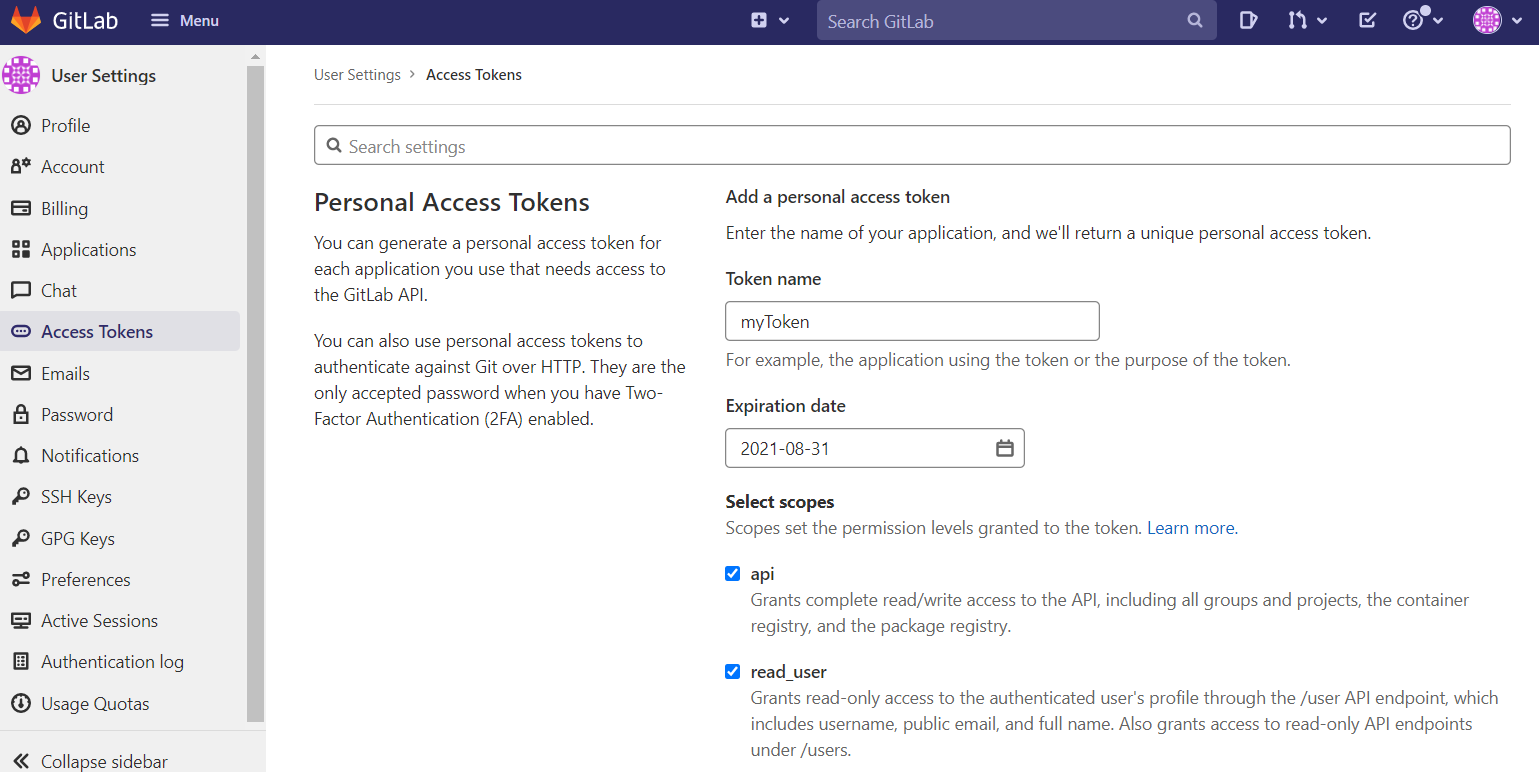
Click 'Create personal access token', and your token will be generated and displayed on screen. Copy or save this token since you can't access it again.
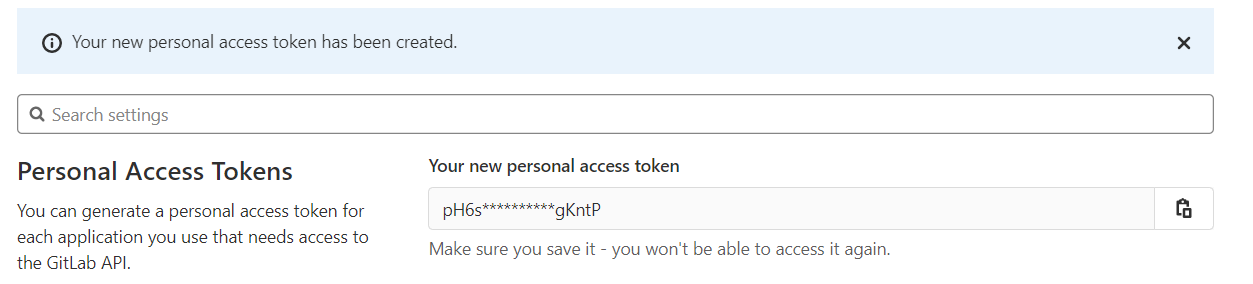
Note: Project access tokens and group access tokens are also accepted in place of a personal access token.
Access Token secret
Create a secret containing your access token:
apiVersion: v1
kind: Secret
metadata:
  name: gitlab-secret
  labels:
    type: gitlab
type: Opaque
stringData:
  token: "**access token goes here**"
Configuring the secret store
Be sure the gitlab provider is listed in the Kind=SecretStore and the ProjectID is set. If you are not using https://gitlab.com, you must set the url field as well.
In order to sync group variables inheritFromGroups must be true or groupIDs have to be defined.
Note:
inheritFromGroupsandgroupIDsare mutually exclusive. Setting both fields at the same time causes a validation error. UsegroupIDsto sync from a fixed list of groups, orinheritFromGroups: trueto automatically discover all parent groups of the project.
The values in groupIDs must be the numeric group ID, not the group path or slug. You can find the numeric ID on the group's General Settings page.
When inheritFromGroups: true is set, parent groups are discovered at secret-fetch time via the GitLab Projects API and sorted by full path length, shortest first. This gives the project's direct parent the highest priority among groups. Project variables always take precedence over group variables regardless of this order.
In case you have defined multiple environments in Gitlab, the secret store should be constrained to a specific environment_scope.
Environment Scope Fallback Behavior
The GitLab provider implements an intelligent fallback mechanism for environment scopes:
- Primary lookup: When you configure a specific
environmentin your SecretStore (example:environment: "production"), the provider first tries to find variables with that exact environment scope. - Automatic fallback: If no variable is found with the specific environment scope, the provider automatically falls back to variables with "All environments" scope (
*wildcard). - Priority order: Variables with specific environment scopes take precedence over wildcard variables when both exist.
Example: If your SecretStore has environment: "production" but your GitLab variable is set to "All environments", the variable will still be successfully retrieved through the fallback mechanism.
Implementation Note: This fallback behavior is implemented in the
getVariablesfunction inproviders/v1/gitlab/provider.go, where the provider automatically retries withEnvironmentScope: "*"when the initial lookup with the specific environment scope returns a 404 Not Found response. The same fallback applies to group variable lookups ingetGroupVariables.
apiVersion: external-secrets.io/v1
kind: SecretStore
metadata:
  name: gitlab-secret-store
spec:
  provider:
    # provider type: gitlab
    gitlab:
      # url: https://gitlab.mydomain.com/
      auth:
        SecretRef:
          accessToken:
            name: gitlab-secret
            key: token
      projectID: "**project ID goes here**"
      # To sync variables from specific groups, provide their numeric IDs
      # (visible on the group's General Settings page).
      # groupIDs and inheritFromGroups are mutually exclusive: set only one.
      groupIDs: ["12345", "67890"]
      # Alternatively, automatically inherit variables from all parent groups:
      # inheritFromGroups: true
      environment: "**environment scope goes here**"
ClusterSecretStore, Be sure to provide namespace in accessToken with the namespace where the secret resides.
Your project ID can be found on your project's page.

Custom TLS certificates
If your GitLab instance uses a self-signed or private CA certificate, configure the provider to trust it using one of two options.
Option 1 -- inline PEM via caBundle: base64-encode your CA certificate and set it directly in the store spec.
apiVersion: external-secrets.io/v1
kind: SecretStore
metadata:
  name: gitlab-secret-store
spec:
  provider:
    gitlab:
      url: https://gitlab.example.com
      auth:
        SecretRef:
          accessToken:
            name: gitlab-secret
            key: token
      projectID: "12345"
      caBundle: LS0tLS1CRUdJTi...  # base64-encoded PEM certificate
Option 2 -- reference a Secret or ConfigMap via caProvider: store the PEM certificate in a Kubernetes resource and point the store at it. This avoids embedding the certificate in the store spec and works well with cert-manager or manually provisioned CA bundles.
apiVersion: external-secrets.io/v1
kind: SecretStore
metadata:
  name: gitlab-secret-store
spec:
  provider:
    gitlab:
      url: https://gitlab.example.com
      auth:
        SecretRef:
          accessToken:
            name: gitlab-secret
            key: token
      projectID: "12345"
      caProvider:
        type: Secret       # or ConfigMap
        name: gitlab-ca    # name of the Secret or ConfigMap
        key: ca.crt        # key inside the resource that holds the PEM certificate
        # namespace: ...   # required only for ClusterSecretStore
Creating external secret
To sync a GitLab variable to a secret on the Kubernetes cluster, a Kind=ExternalSecret is needed.
apiVersion: external-secrets.io/v1
kind: ExternalSecret
metadata:
  name: gitlab-external-secret-example
spec:
  refreshInterval: 1h0m0s

  secretStoreRef:
    kind: SecretStore
    name: gitlab-secret-store # Must match SecretStore on the cluster

  target:
    name: gitlab-secret-to-create # Name for the secret to be created on the cluster
    creationPolicy: Owner

  data:
    - secretKey: secretKey # Key given to the secret to be created on the cluster
      remoteRef:
        key: myGitlabVariable # Key of the variable on Gitlab
Key normalisation
When using data: to look up a single variable by name, hyphens in remoteRef.key are silently replaced with underscores before the GitLab API call. For example, key: my-secret will look up the GitLab variable named my_secret. This normalisation does not apply to dataFrom.
Extracting a JSON sub-key with remoteRef.property
If a GitLab variable holds a JSON string, you can extract a single nested value using remoteRef.property. The value is resolved using GJSON path syntax, so dot-separated paths and array indexing are both supported.
apiVersion: external-secrets.io/v1
kind: ExternalSecret
metadata:
  name: gitlab-json-property-example
spec:
  refreshInterval: 1h0m0s
  secretStoreRef:
    kind: SecretStore
    name: gitlab-secret-store
  target:
    name: gitlab-secret-to-create
    creationPolicy: Owner
  data:
    - secretKey: db-password
      remoteRef:
        key: MY_JSON_CONFIG          # GitLab variable whose value is a JSON string
        property: database.password   # GJSON path into that JSON value
Using DataFrom
DataFrom can be used to get a variable as a JSON string and attempt to parse it, or to match multiple variables by name.
Extracting all keys from a JSON variable (dataFrom.extract):
apiVersion: external-secrets.io/v1
kind: ExternalSecret
metadata:
  name: gitlab-external-secret-example
spec:
  refreshInterval: 1h0m0s

  secretStoreRef:
    kind: SecretStore
    name: gitlab-secret-store # Must match SecretStore on the cluster

  target:
    name: gitlab-secret-to-create # Name for the secret to be created on the cluster
    creationPolicy: Owner

  # each secret name in the KV will be used as the secret key in the SECRET k8s target object
  dataFrom:
  - extract:
      key: "myJsonVariable" # Key of the variable on Gitlab
Matching multiple variables by name regex (dataFrom.find):
apiVersion: external-secrets.io/v1
kind: ExternalSecret
metadata:
  name: gitlab-find-example
spec:
  refreshInterval: 1h0m0s
  secretStoreRef:
    kind: SecretStore
    name: gitlab-secret-store
  target:
    name: gitlab-secret-to-create
    creationPolicy: Owner
  dataFrom:
    - find:
        name:
          regexp: "^PROD_.*"            # required: regexp matched against variable names
        tags:
          environment_scope: production  # optional: also filter by environment scope
The following restrictions apply when using find:
find.nameis mandatory. The provider requires a name regexp to select which variables to sync.find.tagsonly supports theenvironment_scopekey. Any other tag key causes an error. Settingfind.tags.environment_scopewhile the SecretStore already has anenvironmentconfigured also causes an error, as the two would conflict.find.pathis not implemented in the GitLab provider and returns an error if set.
Getting the Kubernetes secret
The operator will fetch the project variable and inject it as a Kind=Secret.
kubectl get secret gitlab-secret-to-create -o jsonpath='{.data.secretKey}' | base64 -d
